

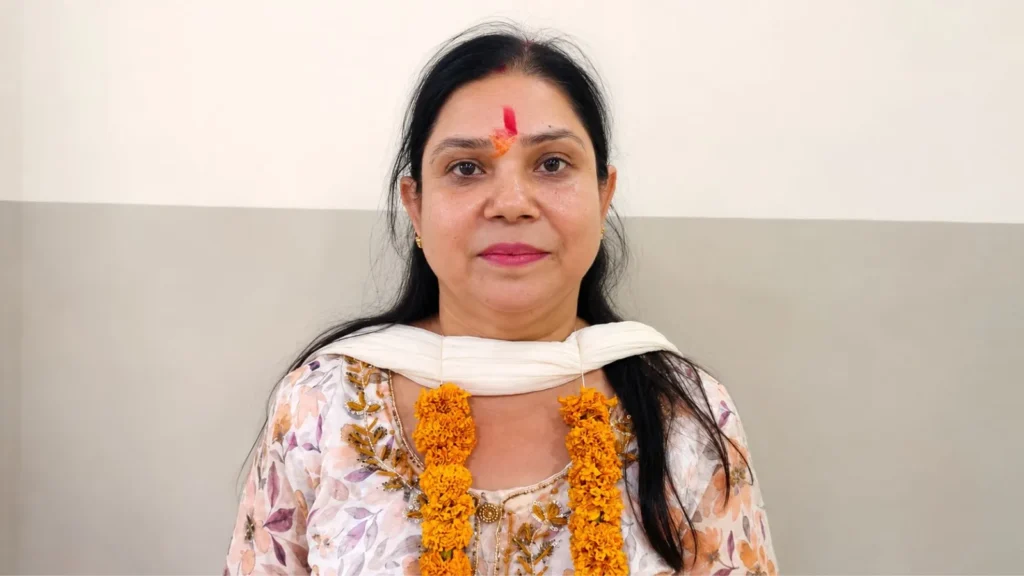
Bharatiya Janata Party leader Pooja Wadhwa has been elected as the first woman mayor of the Abohar Municipal Corporation in Punjab, following a High Court-ordered re-election that overturned a contentious earlier vote in which the Aam Aadmi Party had controversially secured the mayoral post despite the BJP holding a clear majority in the civic body.
A Sweeping Result for the BJP
In the re-election held this week, the BJP swept the Abohar Municipal Corporation polls, securing the top posts and cementing its administrative control over the civic body. Wadhwa’s election as mayor marks a historic first for Abohar, a city long regarded as one of Punjab’s most economically and politically significant urban centres, often referred to as the “California of Punjab” owing to its extensive kinnow cultivation and strong agricultural economy.
Background: A Contested Mayoral Election
Wadhwa’s election comes after months of political and legal wrangling over the Abohar mayoral post. In the original Punjab municipal elections held in May 2026, the BJP delivered a commanding performance in Abohar, winning 28 of the corporation’s 50 wards and crossing the majority threshold on its own, a result that positioned the party to form its first-ever independent mayoral administration in the city. The Aam Aadmi Party, which currently governs Punjab at the state level, finished a distant second with 20 seats, while the Congress and an independent candidate each won a single seat.
Despite the BJP’s clear ward-level majority, however, the subsequent mayoral election produced a starkly different outcome. In a dramatic political turn, the AAP managed to secure all three top posts, Mayor, Senior Deputy Mayor, and Deputy Mayor, with its candidate Ganesh Sablania elected Mayor after securing 27 votes. According to reports at the time, this tally included support from five BJP councillors who allegedly voted in favour of the AAP candidate, along with backing from a Congress councillor and an independent, despite the BJP’s overall numerical strength in the house.
BJP’s Allegations and Protests
The outcome triggered immediate and vocal protests from the BJP, which accused the ruling AAP of engineering defections among its councillors to overturn what it described as the clear mandate delivered by voters. Led by Abohar MLA Sandeep Jakhar, BJP councillors and supporters staged protests outside the offices of senior district officials, including the Ferozepur Divisional Commissioner and the Fazilka Deputy Commissioner, demanding access to official documentation from the mayoral election proceedings.
Former Punjab BJP president Sunil Jakhar also travelled to Abohar to lodge a formal protest with municipal officials over the outcome. The demonstrations reportedly grew tense at points, with police resorting to a mild lathi-charge to disperse protesting BJP councillors and supporters as the party pressed its objections to the result.
The Path to Re-Election
Following the BJP’s sustained legal and political challenge to the original mayoral vote, the matter eventually made its way to the courts. A High Court-ordered re-election was subsequently held, giving the BJP an opportunity to reassert its majority position in a fresh vote for the corporation’s top posts. In this re-election, the party swept the contest decisively, with Pooja Wadhwa emerging victorious as Abohar’s mayor, correcting what BJP leaders had long characterised as an improper subversion of the electorate’s original mandate.
Broader Context: Punjab’s 2026 Municipal Elections
Abohar’s mayoral saga unfolded against the backdrop of a broader set of municipal elections held across Punjab in 2026, covering 102 municipal bodies comprising nearly 1,900 wards across eight municipal corporations, including Mohali, Bathinda, Barnala, Kapurthala, Moga, Batala, and Pathankot, alongside numerous municipal councils. Across this wider electoral landscape, the ruling AAP secured the largest share of wards overall, followed by the Congress, independents, the Shiromani Akali Dal, and the BJP, with the Bahujan Samaj Party picking up a smaller number of seats.
Within this broader picture, Abohar stood out as a notable exception, representing the only municipal corporation in Punjab where the BJP had emerged with an outright majority, making the subsequent dispute over the mayoral post particularly significant for the party’s standing in the state ahead of the crucial 2027 Punjab Assembly elections, in which the BJP has been working to strengthen its foothold.
Why This Result Matters
Beyond its immediate significance for Abohar’s civic administration, the BJP’s eventual victory in the re-election is likely to be viewed by the party as an important political and symbolic win, both in terms of correcting what it viewed as an improperly secured earlier result, and in demonstrating its growing organisational strength within Punjab’s border region ahead of the state’s next assembly polls. For AAP, the loss of the mayoral post it had controversially secured months earlier represents a setback in one of the few urban centres in the state where the party had managed to claim administrative control despite trailing in ward-level results.
Wadhwa’s election as the city’s first woman mayor also adds a notable dimension to the outcome, reflecting a broader pattern seen in municipal corporations across India in recent years, where reserved seats and evolving political dynamics have increasingly brought women into prominent civic leadership roles.
What Happens Next
With the BJP’s administration now formally in place following Wadhwa’s election, attention will turn to how the new mayoral leadership approaches Abohar’s urban development priorities in the years ahead. Given the broader political stakes involved, and the contentious path that led to this outcome, the resolution of the Abohar mayoral dispute is likely to remain a point of reference in Punjab’s evolving political landscape as the state moves closer to its 2027 Assembly elections.