

Climate activist and education reformer Sonam Wangchuk ended his 26-day hunger strike Thursday night after reaching an understanding with the central government over demands related to the NEET-UG paper leak controversy even as the Cockroach Janta Party (CJP) the Gen Z-led movement he had been fasting in solidarity with declared that its broader protest at Jantar Mantar would continue until Union Education Minister Dharmendra Pradhan resigns.
How the Fast Came to an End
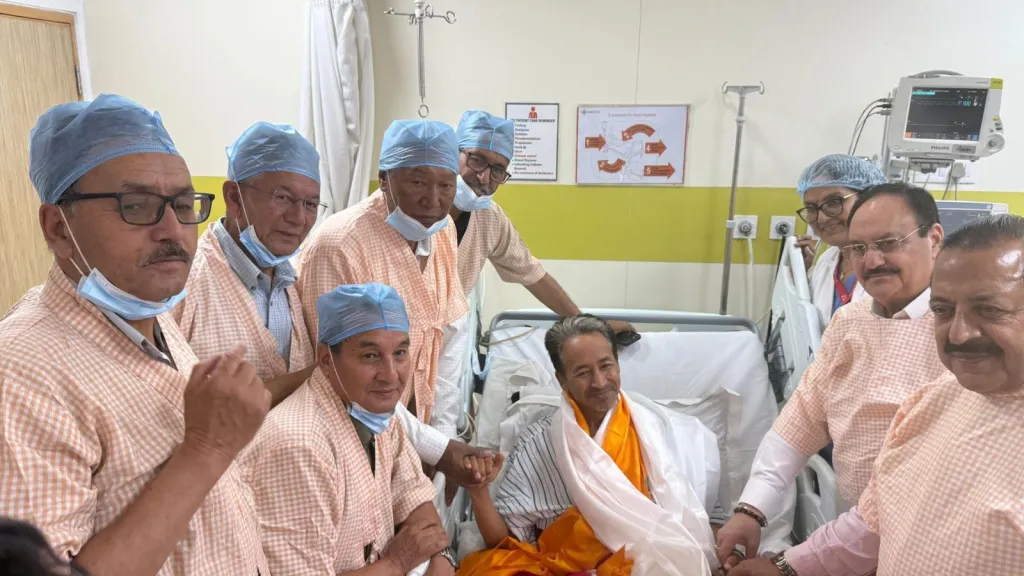
Wangchuk broke his fast at Medanta Hospital in Gurugram, in the presence of Union Ministers J.P. Nadda and Jitendra Singh, as well as senior leaders from the Apex Body of Leh-Ladakh, following what were described as prolonged negotiations with the government. The two ministers had met Wangchuk around Thursday midnight to formally convey the government’s assurances regarding the movement’s key demands.
Explaining his decision, Wangchuk said that 65 Members of Parliament from various political parties had either visited him personally or signed letters urging him to end his fast. He indicated that the decision to break his strike came after extended negotiations and in view of concerns about the possibility of violence, adding that he intended to explain the specific conditions of the agreement in greater detail through a separate video in the days ahead. He specifically urged supporters to remain vigilant against any form of violence at the protest site going forward.
What the Government Assured
According to a video released by the government detailing the assurances given to Wangchuk, the Centre indicated it was positively inclined not to register cases against students who had protested peacefully at Jantar Mantar. The government also confirmed it had already assured a detailed discussion in Parliament on both the NEET paper leak controversy and broader education system reforms, and stated it was positively considering compensation for the families of students who died by suicide in connection with the alleged examination leak.
This government engagement followed Prime Minister Narendra Modi’s own public remarks on the issue a day earlier, in which he had announced the establishment of fast-track courts specifically intended to ensure swift and stringent punishment for those responsible for examination paper leaks.
CJP’s Response: Gratitude, but the Protest Continues
Reacting to news of Wangchuk ending his fast, CJP founder Abhijeet Dipke expressed relief and gratitude, thanking the activist for what he described as his extraordinary courage and sacrifice. In a post on social media platform X, Dipke said that by putting his own life on the line, Wangchuk had awakened the conscience of the entire nation, and stressed that his life remained far too precious to the country to have been placed at further risk.
Despite this note of gratitude Dipke was equally clear that the CJPs own agitation was far from over. He stated unequivocally that the partys peaceful protest at Jantar Mantar would continue until Education Minister Dharmendra Pradhan resigns, indicating that Wangchuks decision to end his fast did not signal an end to the broader movements core demands. The CJPs official X account separately posted content specifically demanding Prime Minister Modis resignation well underscoring that significant distance remains between the movements demands and the governments current assurances.
The Movement’s Core Demands
Beyond Pradhan’s resignation, the CJP has continued to press for a broader set of demands, including full accountability over alleged irregularities in the NEET-UG and other competitive examinations, systemic reforms to India’s examination and education system, and compensation of Rs 1 crore for the families of students who died by suicide in connection with the alleged paper leak.
A Long and Difficult Fast
Wangchuk had joined the CJP-led protest at Jantar Mantar on June 28 in solidarity with the movements demonstrations before beginning his indefinite hunger strike shortly thereafter. Over the course of the ensuing 26 days his health deteriorated substantially with reports at points during the fast indicating significant weight loss and close medical monitoring at the protest site. His continued fast had also become the subject of a Delhi High Court petition seeking directions for his hospitalisation. If medically necessary force-feeding, reflecting the scale of concern that had built around his wellbeing as the strike extended into its fourth week.
The fast additionally drew a range of public appeals for Wangchuk to stop, including from opposition leaders across party lines given his prominent public profile as an engineer-turned-education-reformer whose life story inspired the character Phunsukh Wangdu in the Bollywood film 3 Idiots, as well as his long history of hunger strikes in support of causes including Ladakh statehood and Sixth Schedule protections.
A Pattern Consistent With Wangchuks Past Protests
This is not the time Wangchuk has ended a hunger strike following government engagement or assurances rather than the full resolution of his underlying demands. In protests centred on Ladakhs constitutional status he had similarly concluded fasts, including a 21-day strike in Leh in March after describing them as merely the “first phase” of a longer agitation indicating that fasting has historically served as one tool within a broader sustained campaign strategy for Wangchuk rather than a singular all-or-nothing endpoint.
Why This Matters
The resolution of Wangchuks fast even as the broader CJP protest continues reflects the complex and layered nature of the current standoff between the government and the student-led movement. While the governments assurances regarding fast-track courts, parliamentary discussion and non-prosecution of protesters represent meaningful concessions the CJPs continued insistence on Pradhans resignation signals that the core political demand driving the protest remains unmet setting up continued tension between the movement and the government in the days ahead.
What Happens Next
With Wangchuk’s health now expected to stabilise following the end of his fast, attention will turn to how the CJP sustains its Jantar Mantar protest going forward, and whether the government’s assurances on parliamentary discussion, non-prosecution, and compensation are translated into concrete action in the near term. Given the CJP’s explicit statement that its agitation will continue until Pradhan’s resignation, a demand the government has shown no indication of meeting, further developments in this prolonged standoff are likely in the days and weeks ahead.