

The Delhi High Court became the first court in the country to act on Prime Minister Narendra Modi’s announcement regarding fast-track courts for examination paper leak cases, constituting a specially designated Fast Track Court on Thursday, just hours after the Prime Minister’s statement, to exclusively try offences under the Public Examinations (Prevention of Unfair Means) Act, 2024.
What the Delhi High Court Ordered
In an order issued by the Registrar General, the Delhi High Court confirmed that Chief Justice D.K. Upadhyaya had directed the posting of judicial officer Anu Grover Baliga as Special CBI Judge (Prevention of Corruption Act) to head the newly created Fast Track Court, based at the Rouse Avenue Courts Complex in New Delhi. The court has been designated to exclusively try offences under the Public Examinations Act, along with any connected offences arising from the same cases, allowing for a more focused and expedited judicial process specifically for paper leak-related prosecutions.
The Delhi High Court further directed that the newly designated court would function under the administrative control of the Principal District and Sessions Judge-cum-Special CBI Judge, establishing a clear supervisory structure for the court’s operations going forward.
National Rollout Beyond Delhi
Delhi’s designated court is not an isolated measure. According to reports, fast-track courts are also being established under the jurisdictions of the Bombay, Madhya Pradesh, and Calcutta High Courts, specifically to hear the four cases registered so far under the anti-paper leak legislation enacted the previous year. This coordinated, multi-state rollout reflects the Central government’s stated intention to ensure nationwide consistency in how paper leak cases, including the ongoing NEET-UG matter, are prosecuted and adjudicated going forward.
Offences under the Public Examinations Act carry provisions for imprisonment of up to five years, and the newly designated courts are expected to significantly reduce the time typically required to bring such cases to trial and conclusion compared to standard judicial proceedings.
Government’s Rationale
The Prime Minister’s announcement, made earlier the same day via a post on social media, had confirmed the government’s decision to establish fast-track courts specifically aimed at ensuring swift and stringent punishment for those found responsible for examination paper leaks. Following the Delhi High Court’s swift response, Union Minister J.P. Nadda reiterated that the Prime Minister’s decision reflected the Central government’s broader commitment to ensuring speedy justice in such cases and safeguarding the future and interests of the country’s youth.
Nadda, who has been designated by the government as the official interlocutor for engaging with protesting students, further confirmed that he remained prepared to hear students’ concerns directly, either at his office or residence, at a time convenient to them, and indicated his continued personal participation in discussions aimed at resolving the underlying grievances driving the ongoing protests.
Context: A Month of Sustained Student Protests
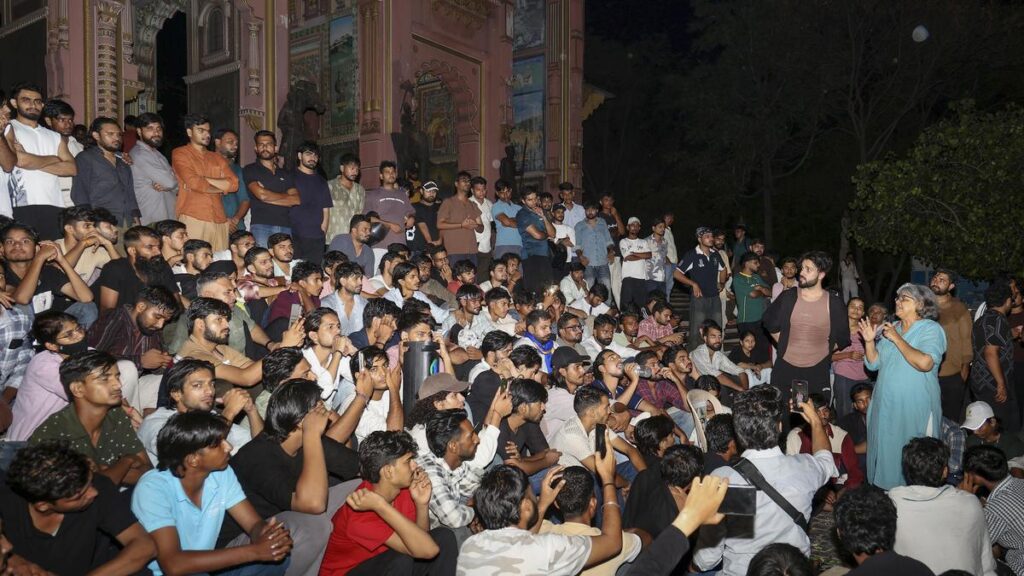
The Delhi High Court’s swift action comes against the backdrop of student-led protests over the alleged NEET-UG paper leak, which have continued at Jantar Mantar for more than a month under the banner of the Gen Z-led Cockroach Janta Party (CJP). Despite sustained engagement efforts, consultations between the Union government and protesters had, up to this point, largely failed to yield a clear breakthrough on the movement’s core political demand, the resignation of Union Education Minister Dharmendra Pradhan.
The announcement and subsequent judicial action follow closely on the heels of climate activist Sonam Wangchuk ending his 26-day hunger strike, undertaken in solidarity with the CJP’s protest, after receiving assurances from the government on related matters, including the establishment of these very fast-track courts, a commitment to parliamentary discussion on the issue, and consideration of compensation for the families of students who died by suicide in connection with the alleged leak. Even as Wangchuk’s fast concluded, the CJP has maintained that its broader protest at Jantar Mantar will continue until Pradhan’s resignation.
A History of Paper Leak Prosecutions in India
Examination paper leak cases are not a new phenomenon within India’s judicial system, though the scale of national attention on the NEET-UG controversy has added particular urgency to strengthening the country’s prosecutorial framework in this area. In one previous high-profile case, a Delhi court sentenced a former Punjab and Haryana High Court registrar to five years in prison in August 2024 in connection with the 2017 Haryana Civil Services (Judicial Branch) examination paper leak, with the presiding judge specifically noting that restoring public faith in the examination process required effective implementation of stringent laws, alongside longer-term structural reforms aimed at improving transparency and fairness in public examinations more broadly.
The Public Examinations (Prevention of Unfair Means) Act, 2024, under which the newly designated fast-track courts will operate, was itself introduced specifically to strengthen the legal framework governing examination integrity following a series of high-profile paper leak controversies in preceding years.
Why This Development Matters
The Delhi High Court’s swift response, moving from the Prime Minister’s announcement to a formal judicial order within hours, has been noted by observers as a notable example of rapid institutional action once clear political direction is provided. For students and families affected by the NEET-UG controversy specifically, and for the broader movement of protesters who have sustained weeks of demonstrations at Jantar Mantar, the establishment of a dedicated fast-track court represents a concrete, tangible step toward addressing one of the CJP’s core demands regarding accountability for those responsible for examination malpractice.
However, given that the CJP has explicitly stated its protest will continue until Education Minister Pradhan’s resignation, a demand this particular measure does not address, the fast-track court’s establishment is likely to be viewed as a significant, but ultimately partial, response to the broader set of grievances driving the ongoing demonstrations.
What Happens Next
With the Delhi High Court’s Fast Track Court now formally constituted and expected to begin handling relevant cases, including matters connected to the NEET-UG controversy, attention will turn to how quickly similar courts become operational in Maharashtra, Madhya Pradesh, and West Bengal under their respective High Courts. Given the continuing protests at Jantar Mantar and the CJP’s unmet demand for Pradhan’s resignation, further developments in the broader standoff between the government and student protesters remain likely in the days ahead, even as this specific judicial measure moves toward implementation.