

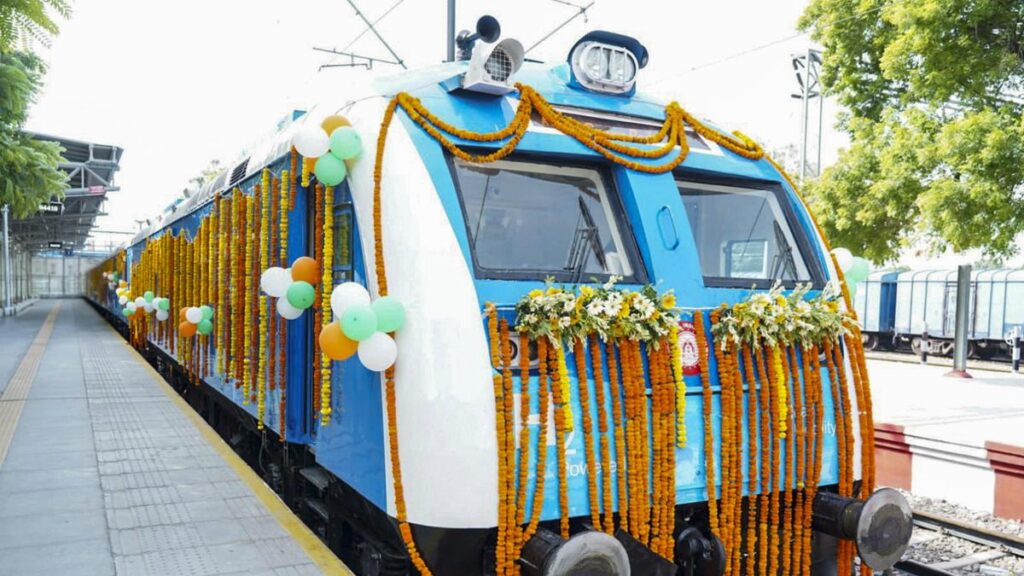
Prime Minister Narendra Modi flagged off Indias hydrogen train on Friday, July 17. This is a step for Indias rail transport. The train will run on the 89-kilometre Jind-Sonipat section of Northern Railway in Haryana. The train will go through stations like Gohana and other stops.
How the Train Works
This train is different from diesel or electric trains. It runs on hydrogen fuel cells. These cells make electricity from hydrogen and oxygen. The only things that come out are water and heat. This makes it a zero-emission transport. It’s good for routes where putting up wires is not easy or cheap.
A Big Engineering Achievement
Indias hydrogen train is special. It has a 1,200 horsepower engine. This is the powerful hydrogen train engine in the world. Other countries have trains with 500 to 800 horsepower engines. This train can go 110 kilometres per hour. Carry 2,600 people.
The 10-coach train was made in India by the Integral Coach Factory (ICF) in Chennai. They worked with Indian Railways to make this train. It’s part of a plan to make mobility.
Dedicated Hydrogen Infrastructure at Jind
To support the train’s daily operations, a dedicated hydrogen production and refuelling facility has been established specifically at Jind. The plant produces hydrogen through an electrolysis process, a method considered central to the generation of what is known as green hydrogen, and has a storage capacity of 3,000 kilograms to ensure a reliable and continuous fuel supply for the train’s regular service. A stable, uninterrupted 11 kV power supply has also been arranged to support the facility’s operations.
Part of a Larger “Hydrogen for Heritage” Vision
The Jind-Sonipat train forms the pilot project under Indian Railways’ broader “Hydrogen for Heritage” initiative, an ambitious plan under which a total of 35 hydrogen-powered trains are planned for deployment across various heritage and hill routes throughout the country. According to railway officials, each individual train is expected to cost approximately Rs 80 crore, with an additional Rs 70 crore earmarked for route-specific ground infrastructure required to support hydrogen refuelling and operations at each location.
The Ministry of Railways has allocated a substantial Rs 2,800 crore toward the broader development of this fleet of 35 hydrogen fuel cell-based trains, reflecting the scale of investment being directed toward this emerging green rail technology. While officials have acknowledged that initial running costs for hydrogen trains are likely to be higher than those of conventional diesel trains, they expect these costs to decline over time as the hydrogen train fleet expands and the surrounding technology and infrastructure ecosystem matures.
Aligning With India’s Net-Zero Ambitions
The hydrogen train project helps Indian Railways achieve zero carbon emissions. This is part of Indias plan to reach zero emissions by 2070. Indian Railways is moving to technologies. They’re using electrification, renewable energy and now hydrogen trains.
Railway Minister Ashwini Vaishnaw said the hydrogen train project is a pilot. It was developed according to specifications by the Research, Design and Standards Organisation (RDSO).
A Milestone Years in the Making
The journey toward Friday’s launch involved a series of incremental engineering milestones over the preceding months. The first hydrogen-powered coach, referred to as the Driving Power Car, was successfully tested at ICF Chennai, followed by testing of the second power car, before all ten coaches were eventually integrated into the completed train set. Following integration, the train underwent extensive trials and conditioning at ICF’s Villivakkam premises, with final testing carried out by Northern Railway, given that the broader operational ecosystem for hydrogen trains, including the Jind refuelling facility, was specifically established under Northern Railway’s jurisdiction.
Global Context
With the successful launch of this train, India joins a select group of countries, including Germany, China, and the United Kingdom, that have adopted hydrogen rail technology as part of their national transport strategies. Given the significantly higher horsepower rating of India’s indigenously developed hydrogen engine compared to existing international designs, officials have suggested that the achievement reflects not just India’s entry into this technological space, but a position of genuine engineering leadership within it.
What Comes Next
The success of the Jind-Sonipat train could lead to hydrogen trains on other routes. This could reduce Indian Railways dependence on fuels and lower emissions. More hydrogen trains are expected on heritage and hill routes, in the coming years.