

New Delhi:
Rajya Sabha MP Raghav Chadha, who recently switched from the Aam Aadmi Party (AAP) to the Bharatiya Janata Party (BJP), broke his silence on the NEET paper leak controversy on Thursday, explaining that his role had fundamentally changed now that he sits on the treasury benches rather than in the Opposition.
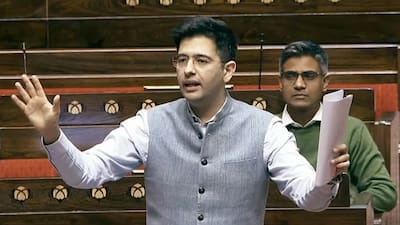
From Opposition to Treasury Benches: A Changed Role
Speaking during the debate on the Public Examinations (Prevention of Unfair Means) Amendment Bill, 2026, in the Rajya Sabha, Chadha addressed criticism over his prolonged silence on the NEET paper leak issue, which had sparked nationwide student protests in recent weeks. “Earlier, when I was in the Opposition, it was my job to raise questions, and I did it honestly. Now I am on the treasury benches, so my role has changed. My responsibility is no longer to ask questions but to provide solutions,” he said. His remarks were made amid a degree of uproar in the House, with the Chair asking Opposition members to allow him to complete his address.
‘We Need Institutional Solutions, Not Headlines’
Addressing the criticism directly, Chadha said he did not believe in appearing before cameras merely to “mark attendance” or chase headlines, arguing that serious issues like paper leaks required institutional, systemic responses rather than media soundbites. He described the anger of protesting students as fully justified and said Prime Minister Narendra Modi had responded to their concerns “like a guardian,” bringing in what he called India’s first comprehensive anti-paper leak framework.
Key Announcements: Computer-Based NEET Testing
Chadha announced that future NEET examinations would move to a computer-based testing system, replacing the current OMR sheet-based format, as part of efforts to reduce the scope for paper leaks. He also noted that the CBI investigation into the NEET paper leak case had been fast-tracked, with a chargesheet filed in a special court within 75 days.
Support for the Bill
Chadha extended strong support to the Public Examinations Amendment Bill, describing it as treating paper leaks as organised crimes carried out by syndicates — targeting coaching mafias, printing-press staff, solver gangs, logistics providers, and compromised exam officials — rather than as isolated incidents. He noted the Bill’s offences have been made cognisable, non-bailable, and non-compoundable, with fines of up to ₹10 crore.
Political Reactions
Chadha’s remarks, along with his defection from AAP, have added a fresh dimension to the ongoing political debate around the NEET paper leak issue. While Opposition leaders continue to question the timing and motivation behind his earlier silence, his supporters within the BJP have framed his comments as reflecting a solutions-oriented approach to governance.
Note: This report is based on statements made in Parliament and information available at the time of publication.