

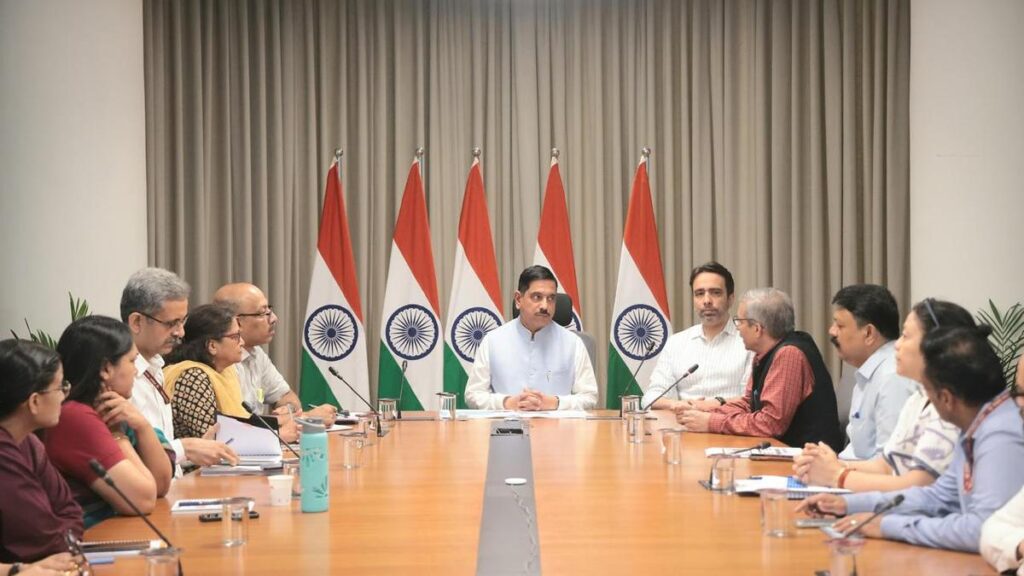
Union Minister Pralhad Joshi has been appointed as India’s new Education Minister, taking charge on Sunday following the resignation of Dharmendra Pradhan, whose exit from the Union Council of Ministers came after weeks of sustained student-led protests over alleged irregularities in the NEET-UG examination. Joshi will hold the Education portfolio in addition to his existing ministerial responsibilities.
How the Appointment Came About
According to an official government release, President Droupadi Murmu, acting on the advice of Prime Minister Narendra Modi, accepted Dharmendra Pradhan’s resignation from the Union Council of Ministers with immediate effect, under clause (2) of Article 75 of the Constitution of India. The same release confirmed that the President had subsequently directed that Pralhad Joshi, already a Cabinet Minister, be assigned charge of the Ministry of Education, in addition to the portfolios he already held.
Joshi’s Existing Responsibilities
Prior to this appointment, Joshi was serving as the Union Minister of Consumer Affairs, Food and Public Distribution, as well as Minister of New and Renewable Energy, positions he has held since June 2024. He will continue to hold both of these portfolios alongside his new responsibilities at the Education Ministry. Joshi brings considerable ministerial experience to the role, having previously served as Union Minister of Coal and Mines, as well as Union Minister of Parliamentary Affairs, between 2019 and 2024.
A long-serving Bharatiya Janata Party leader, Joshi has represented the Dharwad constituency in Karnataka in the Lok Sabha since 2004, and previously served as president of the BJP’s Karnataka state unit between 2012 and 2016.
Joshi’s Reaction to the Appointment
Responding to news of his appointment, Joshi said he would fulfil the new responsibility with complete humility and dedication, signalling his intent to take on the sensitive portfolio at a particularly challenging moment for India’s education system, given the scale of public attention on examination-related concerns in recent weeks.
Why Pradhan Resigned
Announcing his resignation, Dharmendra Pradhan stated that he had submitted his resignation to Prime Minister Modi in the interest of students, and to ensure that the ongoing protests over examination irregularities were not exploited by what he described as “anti-national forces.” His resignation followed weeks of nationwide protests over alleged irregularities in competitive examinations, with student groups demanding greater transparency, accountability, and comprehensive reforms to India’s examination system.
CJP Withdraws Its 37-Day Protest
In a significant development following Pradhan’s resignation, the Cockroach Janta Party (CJP), the Gen Z-led movement that had spearheaded the sustained protests at Jantar Mantar, announced that it was withdrawing its 37-day-long agitation in what it described as a gesture of “good faith.” The group’s decision came after Pradhan’s exit from the Council of Ministers, alongside assurances the movement had received on other core demands raised over the course of its extended demonstration.
The CJP’s protest, which had drawn national attention over more than a month, including through climate activist Sonam Wangchuk’s 26-day hunger strike undertaken in solidarity with the movement, had consistently centred on demands for Pradhan’s resignation, accountability over the alleged NEET-UG paper leak, and broader examination system reforms. With Pradhan’s resignation now secured and the CJP’s protest formally withdrawn, the prolonged standoff between the movement and the central government appears to have reached its resolution.
A Portfolio With Immediate Challenges
Joshi steps into the Education Ministry at a moment when the department faces significant scrutiny following the extended protests, and will be expected to oversee the government’s follow-through on commitments made during the standoff, including the establishment of fast-track courts for paper leak cases, a measure announced by Prime Minister Modi and swiftly acted upon by the Delhi High Court in the days preceding Pradhan’s resignation.
Joshi’s own recent public engagements on education matters offer some indication of his priorities heading into the role. In remarks made shortly before his appointment, he had spoken about the National Education Policy (NEP) 2020 as a transformative initiative aimed at establishing India as a global knowledge hub, and had separately highlighted funding commitments toward strengthening the country’s network of Indian Institutes of Technology (IITs), including an additional Rs 2,000 crore allocation for IIT Dharwad specifically.
Why This Appointment Matters
Joshi’s appointment marks the government’s formal response to a demand that had remained central to the CJP-led protest movement for over a month, and represents a significant reshuffling within the Union Cabinet in the aftermath of one of the most sustained instances of public protest pressure the Modi government has faced in recent years. As the new Education Minister, Joshi will be tasked with restoring public confidence in India’s examination and education systems, following weeks of intense scrutiny over the alleged NEET-UG irregularities and the broader concerns they raised about transparency and accountability within the sector.
What Happens Next
With Joshi now formally in charge of the Education Ministry and the CJP’s Jantar Mantar protest withdrawn, attention will turn to how the new minister approaches outstanding commitments made during the standoff, including the government’s stated plans for parliamentary discussion on the paper leak controversy and broader education reforms. Given the scale of public attention the issue has drawn over recent weeks, Joshi’s early handling of the portfolio, including any further measures on examination integrity and system reform, is likely to be closely watched by both the public and the student groups who sustained the protest movement leading up to this resolution.