

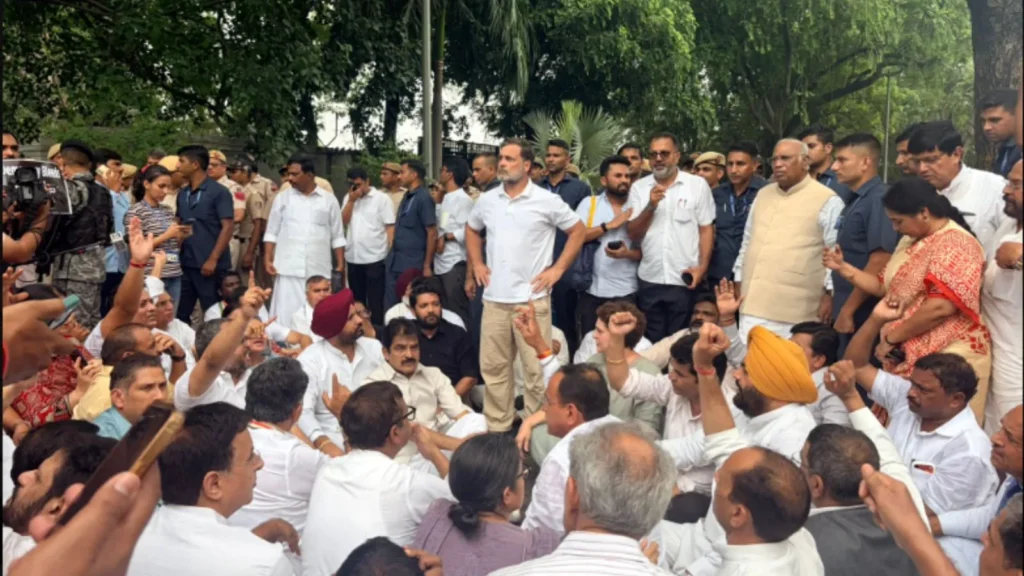
Senior Congress leaders Rahul Gandhi, Priyanka Gandhi Vadra, and party president Mallikarjun Kharge staged a sit-in protest near Prime Minister Narendra Modi’s residence on Tuesday, a day after police used lathi-charge and tear gas to disperse a massive student-led march toward Parliament, escalating a standoff between the government and the youth-driven Cockroach Janta Party (CJP) protest movement.
What Triggered the Sit-In
The Congress leadership’s demonstration came in direct response to Monday’s “Chalo Sansad” march, a call given by the CJP that drew a massive turnout of students and young people attempting to march toward Parliament. According to reports, the scale of the turnout led police to resort to lathi-charge and tear gas to disperse the crowd, resulting in injuries to several student protesters.
Speaking after the sit-in, Congress leaders said they had marched to the Prime Minister’s residence specifically to demand answers over what they described as brutality inflicted on young students the previous day. In a post on social media, the Congress party stated that Rahul Gandhi, Priyanka Gandhi Vadra, and organisation general secretary K.C. Venugopal had marched together, declaring that the Prime Minister and Home Minister needed to answer for what it called the destruction of the futures of India’s youth.
Rahul Gandhi’s Demands
Speaking to reporters within the Parliament House complex, Rahul Gandhi, the Leader of the Opposition in the Lok Sabha, said Prime Minister Modi needed to apologise to students over the police action and called for him to resign alongside Union Home Minister Amit Shah. He described the scenes of young people being beaten as “completely un-Indian,” and expressed frustration that the Prime Minister had not yet issued any apology for the events of the previous day.
Gandhi also detailed an earlier meeting that morning with Lok Sabha Speaker Om Birla, alongside other opposition MPs, in which the opposition had formally requested a parliamentary discussion on the students’ issue. According to Gandhi, the Speaker indicated that he would first need to seek the government’s consent before permitting such a discussion, a response Gandhi characterised as troubling given that it implied the Speaker required government permission to allow debate on the matter within Parliament itself.
Congress Leaders Meet Injured Students
Later on Tuesday, Rahul Gandhi, Priyanka Gandhi Vadra, and K.C. Venugopal met with student protesters who had been injured during the police action, with the party reiterating its demand for the Prime Minister to apologise for what it termed “police brutality” against the country’s youth. The party emphasised that the protesting students’ core demands remained straightforward: accountability from the central government over the alleged NEET-UG examination paper leak, and the immediate resignation of Union Education Minister Dharmendra Pradhan.
Detentions During the Protest
According to reports, several Members of Parliament were detained by police during the course of Tuesday’s demonstrations near the Prime Minister’s residence, though the sit-in by senior Congress leadership continued to draw significant attention throughout the day. The broader wave of opposition criticism extended beyond Congress, with leaders including Pawan Khera, Shashi Tharoor, Sanjay Raut, and Bhupesh Baghel among those who also voiced concerns over the government’s handling of the situation.
Government’s Response
In an apparent effort to de-escalate the standoff, Union Minister J.P. Nadda held talks with CJP spokespersons Saurav Das and Ashutosh Rana following Monday’s clashes, suggesting some level of direct engagement between the government and protest organisers even as political tensions over the incident continued to escalate in Parliament.
Background: The CJP Movement and Its Demands
The Cockroach Janta Party emerged as a Gen Z-led protest movement earlier this year, initially formed in response to remarks made by the Chief Justice of India that had compared unemployed youth to “cockroaches” and “parasites of society.” The movement has since coalesced around demands for accountability over alleged irregularities in the NEET-UG medical entrance examination and other public examinations, alleging that paper leaks earlier this year affected millions of students nationwide.
The protest has continued for weeks at Jantar Mantar in New Delhi, and has drawn considerable public attention in part due to climate activist and education reformer Sonam Wangchuk’s ongoing hunger strike in solidarity with the movement, a fast that has stretched well beyond three weeks and has itself become the subject of a pending Delhi High Court petition seeking medical intervention on his behalf. Following Monday’s clashes, protesters reportedly continued to remain at Jantar Mantar overnight, with large numbers gathering again the following day.
A Politically Charged Moment
The events of the past two days mark a significant escalation in what has already been a prolonged and closely watched standoff between the CJP-led student movement and the central government. The direct involvement of senior Congress leadership, including a sit-in staged near the Prime Minister’s official residence itself, signals a marked intensification of opposition efforts to link the student protest movement to broader criticism of the government’s handling of youth-related grievances, employment concerns, and examination system reforms.
What Happens Next
With Parliament’s Monsoon Session currently underway, the question of whether the government agrees to a formal discussion on the students’ issue is likely to remain a significant point of contention between the ruling party and the opposition in the days ahead. Given the continuing presence of protesters at Jantar Mantar, the unresolved status of Sonam Wangchuk’s hunger strike, and the heightened political attention now surrounding the events of Monday and Tuesday, further developments, including possible government engagement with CJP’s core demands, are likely in the near term.