

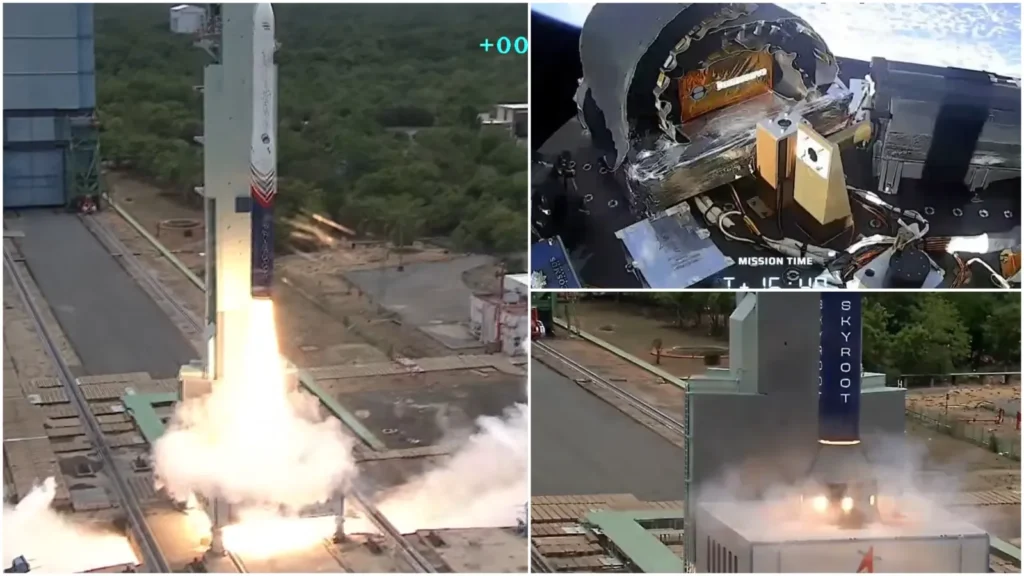
Hyderabad-based space start-up Skyroot Aerospace achieved a landmark moment in India’s private space industry on Friday, successfully launching its Vikram-1 rocket into Earth’s orbit on its very first attempt. The mission, named “Aagaman” (meaning “arrival”), lifted off from the Satish Dhawan Space Centre in Sriharikota at 12:05 pm, carrying six payloads, including two satellites, into low-Earth orbit.
A First-Attempt Success
Vikram-1’s successful orbital insertion on its maiden flight is a particularly notable achievement, given that first orbital launch attempts by new rockets, even from well-established national space agencies, frequently end in failure. According to Skyroot’s mission profile, the rocket accelerated rapidly after liftoff, crossing the speed of sound, or Mach 1, roughly 25 seconds into flight, before reaching Mach 5, five times the speed of sound, within about 90 seconds. Shortly after, the rocket’s first stage separated as planned, allowing the mission to progress through its subsequent flight phases toward orbital insertion.
What Vikram-1 Is and How It Works
Vikram-1 is a four-stage, small-lift launch vehicle designed specifically for cost-effective, rapid, and on-demand deployment of small commercial satellites. The rocket’s first three stages rely on solid-fuel propulsion through Skyroot’s indigenously developed Kalam-series engines, while its upper “kick stage” uses liquid hypergolic propulsion through the company’s Raman engines, enabling more precise orbital insertion and adjustment manoeuvres once in space.
Standing approximately 20 metres tall, Vikram-1 is built using lightweight, all-carbon composite airframes designed to minimise structural mass, along with 3D-printed liquid engines and modular avionics systems, technological choices aimed at making the rocket both lighter and faster to manufacture compared to more conventional launch vehicle designs. The rocket is capable of carrying payloads of up to roughly 480 kilograms to low-Earth orbit, or around 290 kilograms to a Sun-synchronous orbit, positioning it within the growing global market for dedicated small-satellite launch services.
From Sounding Rocket to Orbital Vehicle
Friday’s mission builds directly on groundwork laid by Skyroot’s earlier suborbital rocket, Vikram-S, which made history in November 2022 as India’s first privately developed rocket to reach space, though not orbit, during its debut “Prarambh” mission. That earlier flight helped the company validate several of the core technologies, including its carbon-fibre structural design and 3D-printed thruster systems, that would later be incorporated into the considerably more complex, orbit-capable Vikram-1.
Founded in 2018 by former ISRO scientists Pawan Kumar Chandana and Naga Bharath Daka, Skyroot became the first Indian private space start-up to sign a memorandum of understanding with ISRO for launch cooperation, and has steadily built toward Friday’s milestone through a series of incremental technology demonstrations over the preceding years.
Prime Minister’s Congratulations
Prime Minister Narendra Modi personally telephoned the Skyroot team shortly after the mission’s success to congratulate them, telling company leaders Pawan Kumar Chandana and Naga Bharath Daka that he had watched the entire launch programme live and that their achievement would inspire young people across the country to pursue similar ambitions. Modi specifically remarked on the youthful composition of the Skyroot team, noting that many appeared to be in their mid-to-late twenties or early thirties, a comment reflecting the broader narrative around India’s emerging space start-up ecosystem being driven substantially by younger entrepreneurs and engineers.
Why This Launch Matters
Vikram-1’s successful orbital debut marks a significant milestone in India’s broader effort to open up its space sector to private enterprise, a shift that began in earnest when the government formally opened the sector to private players in 2020. Until now, orbital launch capability in India had remained the exclusive domain of ISRO, the state-run space agency that has dominated the country’s space activities for decades. With Vikram-1’s success, Skyroot becomes the first Indian private company to demonstrate a fully independent orbital launch capability, a milestone that industry observers view as central to India’s ambitions of capturing a meaningful share of the rapidly growing global small-satellite launch market.
The mission’s primary objective, according to Skyroot co-founder and CEO Pawan Kumar Chandana, was to capture detailed in-flight performance data across every system on the rocket, data that will be used to validate the company’s broader design choices and inform the development of subsequent vehicles in the Vikram series as Skyroot works toward building a reliable, high-cadence commercial launch programme.
What Comes Next for Skyroot
With Vikram-1’s successful debut now complete, Skyroot has indicated plans to scale up rapidly toward a higher launch cadence, aiming eventually for monthly launches as the company looks to establish itself as a dependable commercial launch provider. The company is also developing a larger vehicle in the same family, Vikram-II, which is expected to offer substantially greater payload capacity, up to roughly 900 kilograms to low-Earth orbit, powered in part by a more advanced cryogenic upper-stage engine, further expanding the range of missions Skyroot will be able to support as its rocket family matures.
A Broader Moment for India’s Private Space Sector
Skyroot’s achievement adds further momentum to India’s rapidly growing private space industry, which has seen a wave of start-ups emerge in the years since the sector’s liberalisation in 2020, spanning launch vehicles, satellite manufacturing, and space-based data services. A successful first-attempt orbital launch of this nature is likely to bolster investor and customer confidence not just in Skyroot specifically, but in the broader credibility of India’s private space ecosystem as a serious, technically capable participant in the global commercial launch market.