

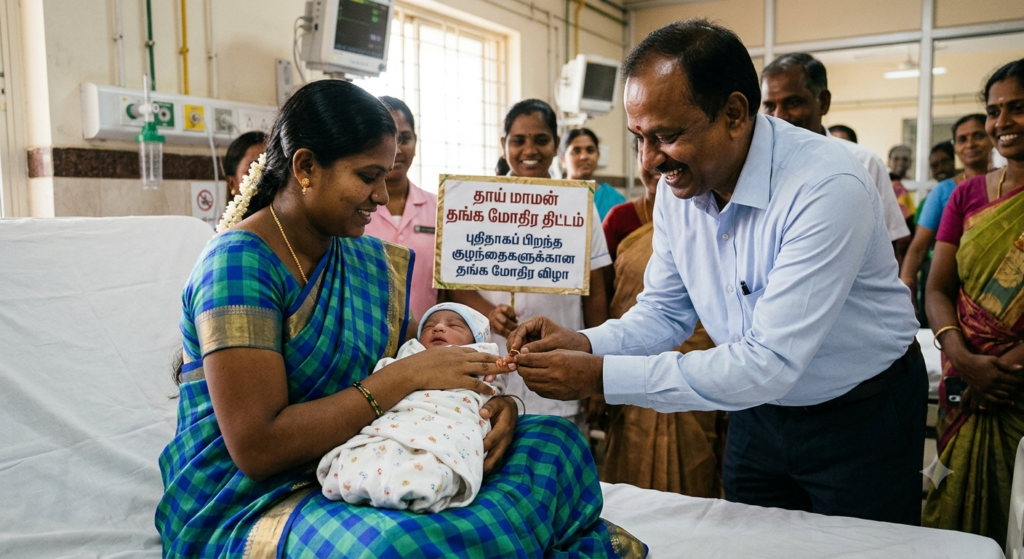
Tamil Nadu has rolled out a distinctive welfare initiative that blends tradition with public health policy. Chief Minister C. Joseph Vijay’s government has officially launched the ‘Thaimaaman Thanga Mothiram Thittam’ (Maternal Uncle’s Golden Ring Scheme), under which every child born in a government hospital across the state will receive a one-gram gold ring as a symbolic gift.
What Is the Scheme About?
The scheme draws its name and inspiration from “Thai Maman Seer,” a deep-rooted Tamil cultural tradition in which a maternal uncle presents blessings and gifts to a newborn baby. Through this initiative, the state government is symbolically stepping into that role — becoming the “maaman” (uncle) for every child born in its public health institutions and gifting a gold ring as a token of welcome, care, and affection.
This was one of the key pre-poll promises made by Vijay and his party, the Tamilaga Vettri Kazhagam (TVK), during the run-up to the 2026 Tamil Nadu Assembly elections. TVK, formed by Vijay two years ago, won 107 seats in its very first electoral outing and now governs in coalition with Congress, VCK, IUML, and Left parties.
Budget and Eligibility
The Tamil Nadu government has earmarked ₹755.83 crore annually for the scheme. At current market rates, each one-gram gold ring is estimated to cost around ₹13,600.
Children born in government hospitals on or after June 22, 2026 — coinciding with the Chief Minister’s birthday — are eligible for the benefit. While eligibility kicks in retrospectively from that date, the scheme will be formally launched on September 15, 2026, marking the birth anniversary of former Chief Minister C.N. Annadurai (Perarignar Anna).
Importantly, the government order clarifies that:
- All pregnant mothers delivering at government institutions, and mothers of newborns, are eligible.
- Coverage extends to every newborn regardless of birth order — mothers with Higher Order Births (HOB) face no restrictions.
- The distribution is entirely gender-neutral, with no discrimination based on the newborn’s gender.
- Beneficiaries must be Tamil Nadu residents and submit residential proof, such as a ration card, voter ID, Aadhaar, a Labour Welfare Board ID, a Department of Posts address proof, or a Nativity Certificate.
How Will It Be Implemented?
To roll out the scheme smoothly, the state government is setting up a dedicated State Project/Programme Management Unit that will implement, monitor, and manage the initiative. The gold rings will be procured through the Tamil Nadu Medical Services Corporation (TNMSC), which will supply them based on an annual indent submitted by the Director of Public Health and Preventive Medicine.
According to government data cited by officials, Tamil Nadu records around 7.8 lakh deliveries annually, with institutional deliveries accounting for 99.9% of all births as per the National Family Health Survey (NFHS-6). This means the scheme is expected to benefit a very large number of families across the state each year.
Why Gold?
The government order explaining the rationale behind the scheme notes that gold holds deep cultural and emotional significance in Tamil Nadu. Gifting gold to a newborn is seen as a way to celebrate the child’s arrival, honour the mother’s journey, and turn a routine hospital delivery into a moment of community pride. Officials also point out that unlike cash transfers, a gold ring remains a lasting keepsake — an asset the family keeps for years, which in turn builds long-term goodwill for the public health system through word of mouth.
The Bigger Picture
Political outfits in Tamil Nadu have historically gifted gold rings to infants born in government hospitals on their leaders’ birthdays as informal gestures. What makes this scheme different is that, for the first time, this practice has been institutionalised as an official state welfare programme, backed by a dedicated budget, an implementation body, and clear eligibility norms — rather than being a one-off political gesture.
Beyond the symbolism, the government says the scheme is meant to strengthen its broader commitment to maternal and child health, encouraging more families to opt for safe, affordable deliveries within the public healthcare system.