

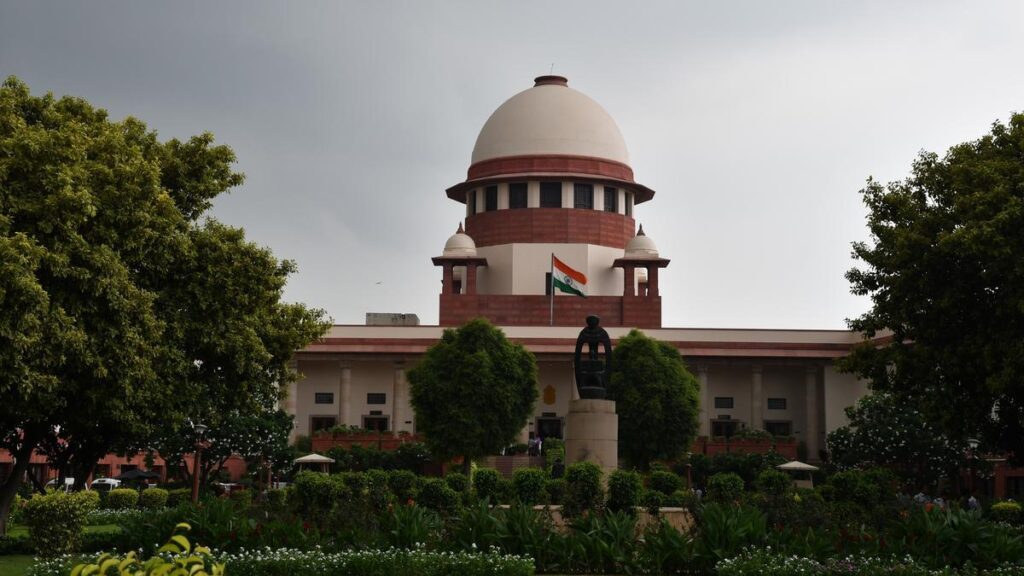
The Supreme Court has granted the Assam government two weeks to file its response to a batch of five petitions challenging orders that declared five women as foreigners alleged to have entered the state illegally, continuing judicial scrutiny of the state’s contentious Foreigners Tribunal process.
What the Court Ordered
A bench comprising Justices Vikram Nath and Sandeep Mehta passed the order after counsel representing the Assam government sought additional time to file counter-affidavits in the five pending petitions. The bench’s order simply stated that, as requested, two weeks had been granted to the state’s counsel to file the necessary vakalatnama and counter-affidavits in all the cases, with the matter to be listed again after that period.
This latest procedural order builds on an earlier direction from June 5, when the Supreme Court had ordered a status quo on the deportation of the petitioners while agreeing to hear their challenges to separate orders passed by the Gauhati High Court. According to submissions made during the hearing, at least two of the women involved in the case are currently in detention, with the top court’s earlier order having specifically stayed their deportation pending further proceedings.
Background: Rejected by the High Court
The five petitioners had originally approached the Gauhati High Court seeking to have orders passed by Assam’s Foreigners Tribunals quashed, orders that had declared them foreigners or illegal migrants alleged to have entered India from Bangladesh without authorisation. The High Court rejected their pleas, prompting the women to escalate their challenge to the Supreme Court.
A Significant Recent Precedent: The July 13 Verdict
During Thursday’s hearing, an advocate representing one of the petitioners specifically referenced a significant Supreme Court verdict delivered just days earlier, on July 13, which held that the determination of an individual’s citizenship status must be carried out through a fair, lawful, and reasoned process. That verdict arose from a separate batch of appeals concerning proceedings before Assam’s Foreigners Tribunals and the erstwhile Illegal Migrants (Determination) Tribunals, and resulted in the apex court setting aside High Court judgments that had earlier affirmed orders declaring certain individuals to be foreigners.
As part of that July 13 ruling, the Supreme Court directed the relevant tribunals to reconsider the disputed references afresh, explicitly instructing them to proceed uninfluenced by any earlier observations made by the High Court in those cases. This verdict appears to have established an important legal benchmark that petitioners in the current batch of cases are now seeking to invoke in support of their own challenges.
A related, separate ruling around the same period saw the Supreme Court set aside ex parte foreigner declarations in 24 additional Assam cases, citing a lack of fair hearing for the individuals concerned. In that matter too, the court directed fresh adjudication by competent tribunals, instructing the appellants involved to appear within four weeks with supporting evidence for their citizenship claims, while ordering that no coercive action be taken against them pending the new proceedings.
The Broader Context: Assam’s Foreigners Tribunal System
Assam’s Foreigners Tribunals are quasi-judicial bodies constituted under the Foreigners Act, tasked specifically with determining whether individuals suspected of being illegal migrants can establish their claim to Indian citizenship. The process traces its roots to the Assam Accord of 1985, which established March 24, 1971, as the cut-off date for determining lawful residency in the state, with individuals unable to prove that they or their forefathers resided in India on or before that date liable to be declared foreigners.
This tribunal-based citizenship determination system has remained a subject of sustained legal and humanitarian scrutiny over the years, with civil society groups and legal advocates raising persistent concerns about due process, the burden of proof placed on individuals, particularly those from economically disadvantaged backgrounds with limited access to historical documentation, and the conditions faced by those held in detention while their cases remain pending.
Wider Legal Developments Around Deportation
The current case forms part of a broader and increasingly active body of Supreme Court litigation concerning the treatment of individuals declared foreigners in Assam. In a separate line of proceedings earlier this year, the Supreme Court had directed the Assam government to expedite the deportation of 63 individuals whose foreign nationality had already been confirmed, expressing sharp displeasure over delays the state attributed to an inability to verify the detainees’ addresses in their countries of origin. The bench in that matter had pointedly questioned why the unavailability of an address should prevent deportation once nationality had already been established.
More recently, a separate plea was filed before the Supreme Court alleging that the Assam government had launched what petitioners characterised as a “sweeping and indiscriminate” drive to detain and deport individuals suspected of being foreigners, in some cases without formal Foreigners Tribunal declarations, nationality verification, or the exhaustion of available legal remedies, reflecting the continuing tension between enforcement efforts and due process concerns in this area.
Why This Case Matters
The current batch of petitions, and the broader body of related litigation now before the Supreme Court, reflects the ongoing legal and humanitarian complexity surrounding Assam’s citizenship determination process. With the July 13 verdict having reinforced the requirement for fair, lawful, and reasoned adjudication in such cases, the outcome of the present petitions, once the Assam government files its response, could carry implications well beyond the five individual petitioners currently before the court, potentially informing how similar cases are handled going forward.
What Happens Next
With the Assam government now required to file its counter-affidavits within the two-week window granted by the court, the matter is set to be listed again thereafter for further hearing. Given the status quo currently in place regarding the petitioners’ deportation, and the broader legal precedent established by the July 13 verdict, the coming weeks are likely to see continued judicial engagement with the underlying due process questions raised across this and related Assam citizenship cases.