

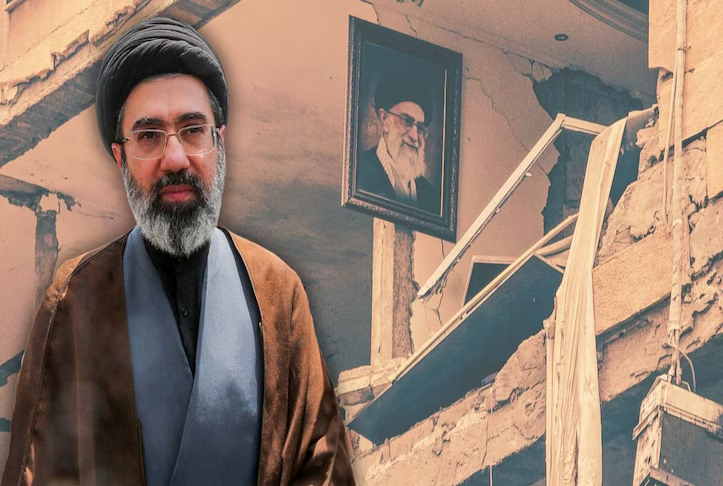
Irans Supreme Leader, Mojtaba Khamenei will not attend the funeral ceremonies for his father, former Supreme Leader Ayatollah Ali Khamenei. This decision was made due to security concerns.
The reason for this decision is that there are Israeli threats and surveillance risks that make any public appearance by Mojtaba Khamenei extremely dangerous. This information came from Ayatollah Hakim Elahi, the leaders representative in India.
Background: A Leader Lost in the War
Ali Khamenei, who led Iran as Supreme Leader for decades was killed in an airstrike on February 28. His death marked a change in Iranian leadership and triggered a transition of power within the Islamic Republics clerical and military establishment. Mojtaba Khamenei then became the Supreme Leader, a role that places him at the centre of Irans political, religious and military apparatus.
Why Mojtaba Is Staying Away
The decision to keep Mojtaba Khamenei away from the funeral is due to fears for his personal safety.This concern was sharply underscored just days before the funeral, when Israeli Defence Minister Israel Katz publicly stated that Iran’s new Supreme Leader was “marked for death.” Katz’s remarks, delivered on Monday, also included pointed characterisations of Iranian negotiators as “good merchants” attempting to extract concessions during ongoing talks, while reiterating that Israel would not permit Iran to develop nuclear weapons — adding that a negotiated outcome to that effect would be preferable, “if they do it through an agreement.”
Foreign Minister Seyed Abbas Araghchi issued a warning to Washington urging US President Donald Trump to “muzzle” officials. In a post on social media platform X, Araghchi asserted that the United States had committed itself, under the terms of a 14-point Memorandum of Understanding (MoU) reached to end hostilities in West Asia, to restraining Israel — and warned that any explicit threat against Iran’s leadership would trigger an immediate response from Tehran.
A Week of National Mouring
Iranian authorities have organised an extensive, multi-day funeral programme for the late Supreme Leader, running from July 4 through July 9, spanning locations across both Iran and Iraq. State media reported that officials are expecting the ceremonies to draw one of the largest public gatherings in the country’s modern history.
According to Brigadier General Hassan Hassanzadeh, commander of the Islamic Revolutionary Guard Corps’ (IRGC) Tehran Command and head of the funeral arrangements headquarters, the core ceremonies will unfold over July 4 and 5, comprising public farewell events, formal funeral prayers, and a funeral procession.
Two major ceremonies are planned in Tehran: A farewell and funeral prayer session at the Imam Khomeini Grand Prayer Grounds ,followed by a seperate funnel in the capital.
Diplomatic Backdrop
The funeral arrangements come at a sensitive diplomatic juncture. Just days earlier, on July 1, Qatar and Pakistan separately concluded rounds of talks with American and Iranian negotiators in Doha, with officials describing “positive progress” on matters tied to the broader 14-point MoU governing the post-war arrangement in the region. Majed Al Ansari, adviser to Qatar’s prime minister and the Foreign Ministry’s official spokesperson, indicated that all parties had agreed to continue discussions in the coming period, with the next round of talks expected to be scheduled only after the conclusion of the former Supreme Leader’s funeral processions.
What it means going forward
Mojtaba Khamenei’s absence from his own father’s funeral — an event of profound religious and national significance in Iran — reflects just how precarious the security situation remains for Iran’s top leadership in the aftermath of the war. It also signals that, even as diplomatic channels involving Qatar, Pakistan, the US, and Iran show signs of cautious progress, the underlying threat environment between Tehran and Israel remains highly volatile, with explicit assassination-related rhetoric now being exchanged at the ministerial level. As the week-long mourning period unfolds, the world will be watching closely to see whether it deepens hostilities further or provides a pause that allows renewed diplomatic momentum to take hold.